Test Notes
Printers test notes
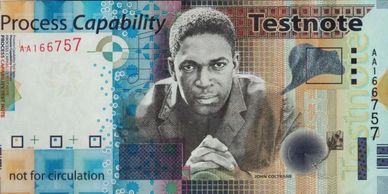
Test notes produced by security printers include Promotional Notes, Advertising Sheets, Color Samples or Charts, Demonstration Notes, and House Notes. These differ sometimes in appearance and most often on how they are utilized.
promotional notes
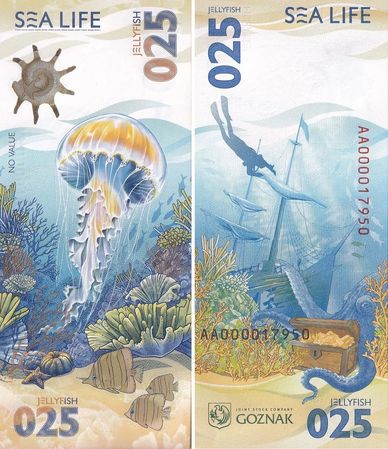
The most common use of modern promotional notes is to tout the firm's security devices and how they can blend these on sample notes. The in-house designers are free to choose images not normally seen on standard banknotes, including historical figures, mythical characters, or modern icons.
These are presented to current and potential customers such as central bank. This can be direct calls by a printers representative or at formal currency conferences such as High Security Printing Conference or Interpol. Because of this use they are also called printers samples or house notes.
color charts
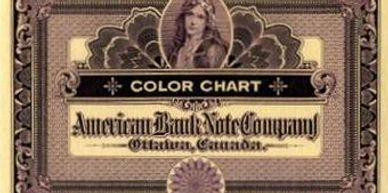
Color charts are a large group of notes with the same images in a complete spectrum of colors. Many of the printers customers prefer to choose specific color schemes for their banknote series. Many countries chose a specific color scheme for each denomination to aid their countrymen in recognizing them quickly and in poor lighting conditions. The color charts or color samples often have in-house notations to ease in determining the color chosen by customers.
advertising sheets

Advertising sheets are also called flyers or more often broadsides. Back in the 1800's these were used to advertise the firm's capabilities and their price ranges. In many countries, private banks were allowed to produce their own banknotes to be exchanged at the firms banks. The banks were most concerned with their banknotes appearing well produced to project a bank on solid ground (whether they were or not). Of course price was a concern and preferred a price break at different levels of produced notes..
experimental notes

Demonstration or experimental notes are produced for at least three reasons.
- When security printers and security device manufacturers submit new developments for patents, these experimental notes provide a visual reference of the new item.
- The Euro is printed by over a dozen security printing firms (all located in the European Union). For consistency and continuity, samples are produced by these firms when a new security device or other major change is made.
- When a security printing machine is commissioned at a security printer, the machine is calibrated, with a demonstration note used rather than a current banknote.
ATM test notes
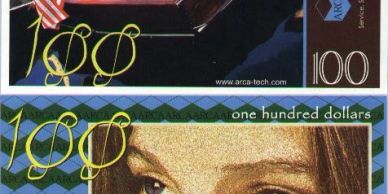
Another entire group of test notes are made for Automatic Teller Machine (ATM) manufactures. These are used for two purposes. Like printers test notes, these are made in a full range of denominations with the manufacturer prominently displayed on the notes. These same notes are also used to calibrate the machines. Carrying a large group of real notes for the technicians would cause a risk easily avoided by using these fake notes. The quality of these test notes is certainly less than the printers counterpart, but they are often quite colorful. With the steady decline of paper money used in commerce and the resulting loss at ATMs deployed, new ATM test notes has nearly stopped.